History of the South Wood County Historical Museum Building
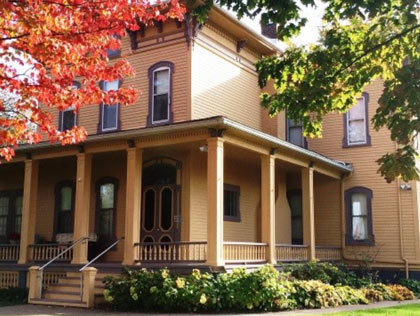
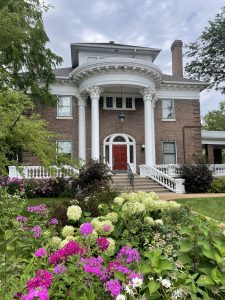
On the site of Isaac’s boyhood home, Anton Billmeyer built Shadowlawn for Isaac Witter in 1907. The house was built on grounds consisting of 230 feet of frontage on Third Street and 230 feet on the Wisconsin River.
The house was built in the neoclassical style, consisting of 23 rooms, not including the large halls, and had a central vacuum system. An elevator was installed after Isaac became ill.
In 1947, Isaac’s brother-in-law, George W. Mead, purchased the Witter home and grounds for $15,000.00 and presented it to the city to house the T.B. Scott Public Library, which opened in 1948.
After the McMillan Memorial Library was built and opened in 1970, the building and land were deeded to the South Wood County Historical Corporation for the museum, which opened in 1972.
Board of Directors
Leon Schmidt, President
Phil Brown, Vice-President
Meg Daly, Secretary
Mary Anne Getzin, Treasurer
Richard Bender
Nick Brazeau Jr.
Mary Olson
Robert Zimmerman
Grant Deuel
John Omernik
Carol Elliott
Scott Paterick
Mission Statement of the South Wood County Historical Corporation
The South Wood County Historical Corporation preserves and interprets the rich heritage of South Wood County, Wisconsin, by collecting, conserving, researching, and exhibiting historical materials that reflect the region’s people and environment. Through permanent and traveling exhibitions—including those of national significance—the Corporation fosters education, inquiry, and public engagement to benefit current and future generations.

Upcoming Events-

Stop by the South Wood County Historical Museum for the annual Ice Cream Social. Serving up vanilla ice cream with a delicious cranberry topping. The museum will be open to visitors during the event.

Two hundred and fifty years ago, American colonists found themselves at war with Great Britain. Yet despite the fighting, independence was far from certain. In fact, the colonies would not formally declare their intention to separate from Britain until July 4, 1776.
What changed?
In the months between the outbreak of war and the Declaration of Independence, no speech, battle, or political leader did more to persuade colonists to embrace independence than Thomas Paine’s influential pamphlet Common Sense. Published in January 1776, Paine’s powerful and accessible arguments helped transform public opinion and inspired many Americans to imagine a new nation.
Join UW-Stevens Point Professor Brett Barker as he explores the ideas, arguments, and remarkable impact of Common Sense. Discover why these 47 pages became one of the most influential political writings in American history and how they helped create the United States.
Dr. Barker has taught U.S. history at UW–Stevens Point since 2002 and currently serves as Chair of the Department of History and International Studies

Are you an antique collector who likes to write? Or a writer who enjoys antiques?
Either way, you’ll have fun with a presentation and a free hands-on workshop coming to the South Wood County Historical Museum from 1:30 to 4:00 p.m. on Tuesday, July 14th.
Local author and typewriter collector Bob Walker will share a few of the historical fiction short stories he has created about the people, places and events his typewriters could have been a part of. From an 1890 Caligraph 2’s experience at the Chicago World’s Fair to a colorful portable Smith-Corona portable’s 1968 adventures in San Francisco, Walker gives his typewriters a first-person voice to share their stories.
Following the presentation of his stories, Walker will guide participants in a hands-on workshop to invent ways that you can tell the stories of your collectibles. Or you can choose any item on display in the Museum to inspire your creative energy.
The true provenance of historical objects is important in scholarly study and appraisal of antiques. But for everyday objects where the origin or background is a mystery, creating a fictional yet plausible “backstory” for an historical item is an easy and fun way to learn more about history while imagining how that particular object might have fit in.
For more information or to register, call the Museum at (715)423-1580, visit online at: https://easyrsvp.net/e/18yPbwuYQ8z, or scan the following QR Code in the image above!